Banking 2026 – challenges and opportunities
| Part 1 |
The year 2025 was also challenging for banks. What can they expect in 2026? We discussed this with our experts Andreas Mach, Rainer Wilken, and Stefan Baumann. This first part of our three-part series “Banking 2026” focuses on the challenges and opportunities for banks in 2026 and the role that artificial intelligence can play in this context.

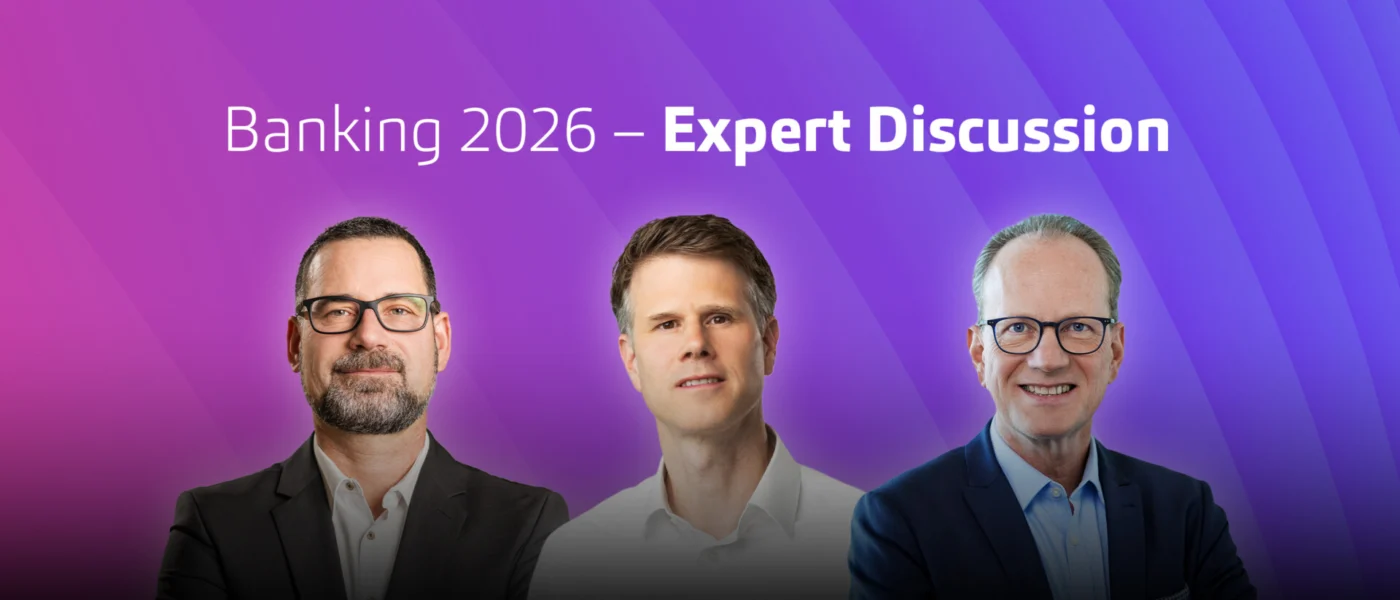
Banking 2026: Challenges, opportunities and the role of AI
The year 2025 was challenging in many respects, including for banks. What can banks expect in 2026? We talked about this with Andreas Mach, Member of the Management Board, Rainer Wilken, Head of Management & Business Consulting and Stefan Baumann, Head of Management Consulting.
In this first part of our three-part series “Banking 2026”, we look at the challenges and opportunities for banks in 2026 and the role that artificial intelligence can play in this. Andrea Späth and Karin Dohmann ask the questions.
By the way: At msg for banking, we are on first-name terms across all hierarchies and continue to do so in our interviews with colleagues.
Artificial intelligence: 2026 will be the year of change for banks
Thank you, Andreas, Rainer and Stefan, for taking the time to talk to us about the opportunities and challenges for the banking industry in 2026. What is your forecast? What will banks be facing in 2026?
Rainer Wilken: “When we look at the markets and economic development, for which only slight growth is forecast for 2026, I believe that banks will continue to struggle with increased risk costs. Due to the recession and the weak economy, they must continue to expect that borrowers –especially small and medium-sized enterprises – will require more intensive support or could default altogether.“
Stefan Baumann: ”Basically, banks have had a good year and a half, driven primarily, of course, by a favorable interest rate environment.
But economic development now leaves much to be desired, putting pressure on earnings and risks. And even if the 500 billion from the special fund is now coming, the money will probably go selectively to certain industries. This means that many of the smaller banks in particular will not benefit from this, or only to a limited extent.
The economic environment for banks is therefore becoming more difficult. Added to this is growing competition from neo-banks, non-banks, and other players in the market.
I therefore suspect that 2026 will tend to be a difficult year for banks – albeit from a high level.”
Rainer Wilken: The question is indeed when the effects of a fiscal policy turnaround on the part of politicians will be seen. So far, there has been no sign of the special fund that has just been mentioned. From the development bank environment, I know that people are waiting to be able to invest it in infrastructure projects, education, or digitization, thereby stimulating the markets.
The money has been announced, but it has not arrived yet. This knot must now be broken, otherwise the banks will also be affected.”

Andreas Mach: “Above all, I see the issue of cost pressure. Due to increased competition, banks have to cut costs, and this will lead to extensive transformations, especially in technology. From the “renovation” of IT architecture to the merging of a wide variety of data bases, from a standardised and targeted approach to customers to the reduction of regulatory costs while simultaneously increasing regulatory resilience – banks have a lot to look forward to.
Banks must also ask themselves how they can establish data sovereignty and security in the face of increasing cyberattacks from outside so that their customers trust them. Ultimately, the decisive factor will be how they can properly measure and mitigate the resulting risks and whether their capital is sufficient to do so.
This will mean that many more scenario analyses will be required than is the case today. And banking supervision will certainly ensure that these topics are also on the agenda of banks and financial service providers in 2026.”
Where there are challenges, there are usually also opportunities. What opportunities will open up for banks in 2026?

Rainer Wilken: “I think that artificial intelligence (AI) in particular offers many opportunities for digitalisation. In particular, the use of AI agents is a huge opportunity for banks to become faster, better and more customer-centric. There are numerous potential applications in the process chains that banks are currently discovering. They will be able to increase their efficiency and improve the customer experience. I absolutely see this as the number one opportunity next year.”
I see great opportunities for banks that focus their business model on interesting, exciting topics, especially for young customers (...).
Andreas Mach Member of the Executive Board
Andreas Mach: I agree. By using AI, banks have the opportunity to tailor their customer approach much more effectively and offer new products. Take ESG, for example. Banks can offer “green” products and thus target precisely those customers who, based on their individual preferences, are particularly interested in this topic.
I see great opportunities for banks that align their business model with interesting, exciting topics, especially for young customers, and also offer solutions that go far beyond banking – in other words, ‘beyond banking’. Banks can use a portal solution to not only help with financing a property and applying for subsidies, but also with selecting the right tradespeople and ensuring that individual needs, such as sustainable practices, are adequately taken into account.
AI helps to provide everything that has nothing to do with actual banking. And it does so without much effort. Some banks have already embarked on this path of focusing on customer centricity, but I still see enormous potential here – especially when it comes to appealing to younger customers, the customers of tomorrow.”

Stefan Baumann: “Especially for savings banks, I think this example is elementary. We have a very competitive banking market in Germany with a large number of banks. This naturally exerts a certain amount of pressure and is a major challenge for the corresponding business model.
Now that technology offers them so many opportunities, banks have the chance to scrutinise which competencies, which target groups they want to focus on and which target products they want to define themselves with.
You no longer have to do everything yourself. There are now companies that can take certain burdens off your shoulders, for example in reporting. The keyword here is outsourcing. This allows you to focus consistently on your business model.”
AI is becoming the new normal. The only thing I doubt is whether it will be that far by 2026.
Rainer Wilken Head of Management & Business Consulting
A keyword has just come up - artificial intelligence. Bank customers are already using it as a matter of course. What about the banks themselves? Is AI already the "new normal" in 2026? Where do they currently stand and in which direction are they heading?
Rainer Wilken: “For a few banks, the use of AI is already normal, especially for large international institutions. They started early and are already very far along at the customer interface.
Then there is a broad middle ground, and then there are those who have not even started yet.
The institutions in the middle have understood that they need an AI strategy and AI governance and may have already developed them. Then they experimented a little: sometimes with an AI use case, sometimes with proof that AI works. And then? Then, in some cases, not much else happened.
My personal impression is that the majority of banks in Germany are stagnating in this middle ground and have not yet gone so far as to implement AI across the board – whether due to regulatory implementation obligations, market difficulties, investment barriers, or similar factors.
But that will come. AI is becoming the new normal. However, I doubt that it will be widespread by 2026. I think we need a little more time.”

Discover more about artificial intelligence
Discover the future of banking: AI technologies are revolutionising the industry. From personalised recommendations to fraud detection, learn how artificial intelligence is making financial services more secure, efficient and customer-centric. Immerse yourself in the world of innovation and experience banking like never before.
Andreas Mach: “It certainly won’t be as early as 2026. There are two main reasons for this: On the one hand, I see the problem of qualifications. Many decision-makers, but also employees, are simply not yet ready to utilise AI adequately enough to create added value.
And on the other hand, in order to use AI in companies in a targeted manner – and not at the experimental stage, but for complete process chains – solutions are needed that deliver stable and correct results and are well thought out and, above all, secure.
However, the industry still has little experience of how the results of AI tools should be appropriately checked to ensure that they fulfil all legal and regulatory requirements. This is why many banks are unsure about what they can and may use at all or how they should deal with hyperscalers and applications in the cloud, for example.
However, it is essential that results generated by AI, for example codes in software development or the use of AI agents in complex processes or the application of machine learning algorithms in risk models, can be used efficiently. This is the only way to achieve the desired time and cost savings and scalability in use. This still requires various test scenarios and solution options to produce comprehensible, explainable and repeatable results.
We will see a great deal of progress in these areas in 2026, especially if we look at the development of language models and the ever-shorter development cycles with sometimes dramatic improvements in results. I would therefore describe 2026 as the year of change for most banks.\”
Stefan Baumann: “The exciting question is not where artificial intelligence can make processes and procedures more efficient, but how AI will change the business model in the long term. I believe that only a few banks have developed a vision of how they can embed AI into their business model in order to generate a competitive advantage. Not only through efficiency, but also through greater customer benefits thanks to new products, targeted marketing, speed, etc.
The exciting question is not where artificial intelligence can make processes and workflows more efficient, but how AI will change the business model in the long term.
Stefan Baumann Head of Management Consulting
It is therefore crucial that banks decide what they want to do with AI models. They can simply use them for reporting purposes. But they can also see AI as an opportunity and, thanks to faster and greater availability of data, operate a solution and business model that is superior to other banks. This makes it all the more important for banks to establish and expand their infrastructure and data management.”
Andreas Mach: “Data strategy is a key issue. Everyone wants to use AI, but we repeatedly find that many banks have no overview of their own data management. They don’t know what structure it has, how consistent it is, or how they can use the available data in a targeted manner. Data storage is often still relatively decentralized and inconsistent, with little flexibility and, in some cases, quite outdated, and it is also unable to integrate unstructured data at all, for example.
But anyone who wants to work with AI solutions or drive digitalization forward must be aware that investing in a future-oriented data economy will be crucial for progress.
This is already an enormous challenge for banks today, one that they must tackle now and continue to optimize in the coming years in order to remain competitive.

Conversational AI: The new customer advisor is called AI
This article shows how artificial intelligence can be used to close the digital advisory gap in banking.
However, banks need a clear data strategy not only in connection with AI, but also for another reason. Namely to standardise their risk management and reporting. Regulators increasingly expect banks to use consistent data in reporting, bank management and risk controlling, as well as in accounting. On the one hand, this should ensure fast and standardised reporting (in accordance with the RDARR standard) and, on the other hand, stress tests and scenario analyses can be implemented quickly.
This will very quickly lead to very granular data, which already plays an important role today, but will also form an elementary basis in the future – for example due to new requirements such as IReF as part of the reporting system.”
Our experts
Andreas Mach, Member of the Executive Board, responsible for Sales and Marketing and for the Management & Business Consulting divisions. In addition, he has been active for many years as an author, speaker, consultant, and expert in the areas of bank management, risk management, controlling, regulation, compliance, analytics, and artificial intelligence.
Rainer Wilken, Business Unit Manager of Management & Business Consulting, has extensive experience in establishing and expanding consulting businesses for financial services, business development, sales management, and customer service, as well as comprehensive expertise in the transformation of banking organizations. His focus is on strategic transformation and technology-driven business models.
Stefan Baumann, Division Manager Management Consulting, has more than 20 years of experience in the banking and finance industry. He supports banks with strategic issues relating to business development and optimization—from mergers, board changes, and business model adjustments to organizational development and the use of modern technologies in the operating model.








You must login to post a comment.